
Part One of Two, as this was getting a bit long.
While I hesitate to say its had anything like a critical revaluation, judging by some online chatter, I do think Final Fantasy XIII boasts a more mild reputation these days, in sharp contrast to the apocalyptic reception it received when released in 2009. This is probably more to do with the title finding an audience than the changing of hearts and minds, but on a site like Backloggd the game boasts a perfectly respectable 3.3/5. I’m glad that such a change happened, as the combination of huge budget with odd design choices deserves a cult appeal.
However, my recent playthrough of FF XIII did not induct me into this particular cult. I skipped it when first released, but curiosity got the better of me this summer. While the game isn’t as bad as its reception among hardcore fans would have you believe, I’m not here as an apologist. I don’t like it. However, how I didn’t enjoy it caused me to think about the broader genre.
I’m no stranger to enjoying the more polarizing entries in the Final Fantasy series1 , but I just couldn’t jive with this one. It’s melodramatic, stifling in its linearity, and downright odd in places. But those flaws are interesting in how they illuminate the delicate balance of design and story that JRPGs must strike.
The Dark Age of Square Enix
Seventeen years of distance allows us to consider this game apart from its original, unfortunate context. The fan backlash to FF XIII was in part because of what the stakes appeared to be for the Final Fantasy series or JRPGs as a whole. The future of JRPGs was uncertain as we transitioned to the HD era. Final Fantasy, as the flagship JRPG series in the West, was looked to as a guiding light for the changing times.
Both FF VII and FF X had kicked down the door of their respective console generations, but with the appeal of the JRPG waning (at least in the west), and the contemporary gaming press often hostile to Japanese aesthetics and design sensibilities, it was hard to see how FF XIII was going to please everyone, despite that clearly being the goal. It was a trap of conflicting expectations: fans and critics wanted the new Final Fantasy game to be both modern (or at least expensive looking) and traditional. No one was quite sure how the JRPG was going to play in the PS3 era, perhaps not even the people making them.
Because make no mistake, in addition to the external pressure of expectations, FF XIII also released at a strange time for Square Enix. Its RPG output at the time (especially those developed in-house) is chock full of oddities. Titles like FF: Crisis Core, The Third Birthday, and whatever the hell was going on with Kingdom Hearts at the time are good examples.
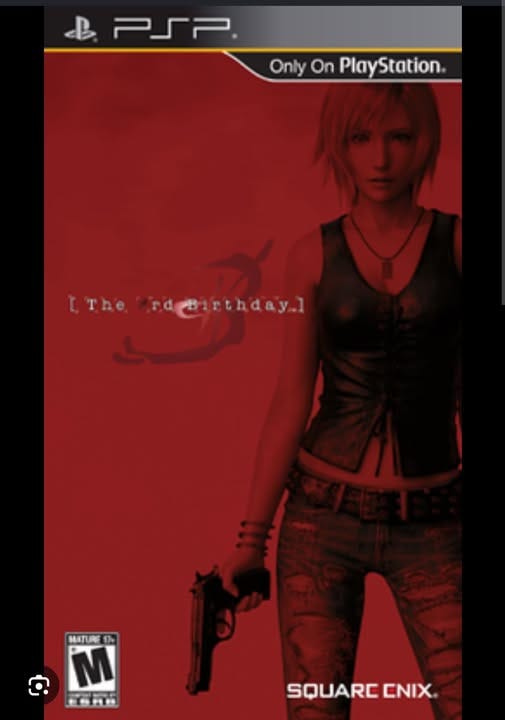
Many of the Square Enix games of this period are, to put it bluntly, rather weird. They are experimental in some laudable ways but feature a parade of needless twists, convoluted worldbuilding, and dire character writing. There was something in the water of those offices, and it produced such gems as multiple characters in Crisis Core getting single wings (because of Sephiroth’s “one-winged angel” shtick during his final boss fight) and flying around with very little commentary.
FF XIII is a hallmark of that. There’s an oddity to the whole endeavor, a privileging of strange aesthetics and stranger storytelling that underlies many of the decisions. At the same time, the anxiety of setting the tone for JRPGs (and being the next entry in such a major franchise) seems to peek through. There is a palpable need in the title to be an Event Game, a rollercoaster of budget and spectacle.
Hubris as Hallways
I won’t fully relitigate the strengths and weaknesses of the game (as that’s the purview of people who spend too much time on reddit) but I will say that there are plenty of things I like about FF XIII, some of which caused others to dislike it. I adored the initial fraught dynamics of the party, coupled with the momentum of the first five hours or so. The group is thrown into a harrowing situation, and many of them aren’t exactly bundles of sunshine and teamwork to begin with. Lightning is an asshole, Snow is a pompous asshole, Vanielle is an idiot, etc. etc. The friction makes sense, while also giving the party as both a group and individuals space to grow.
A related point of praise is how long those arcs are stretched throughout the game. It’s not uncommon for character growth in JRPGs, especially among secondary party members, to stop dead about halfway through the game2. In FF XIII, by contrast, characters are given time to marinate and change slowly3. It gives a good sense of an emotional journey, which shores up what is a rather meandering main story.
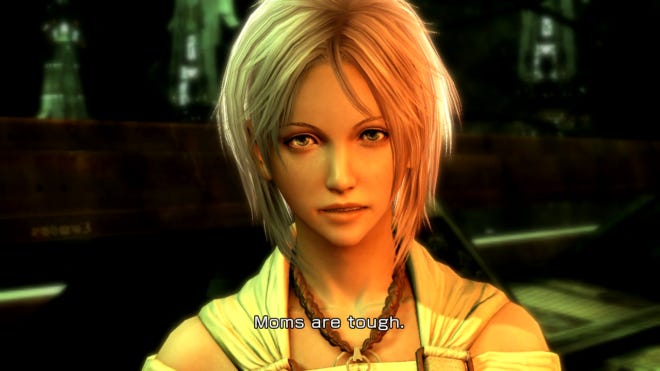
However, this would-be excellent character work is drowned out by soapy melodrama and people talking past each other all the time. Characters don’t have conversations as much as sprout lines and occasional non sequiturs at each other. The moment-to-moment dialogue is just off, for lack of a better term. Everyone speaks like an alien who has mostly, but not quite, learned what language is.
The game is further hampered by a lack of interesting mechanics. I like the battle system, although it feels like a bit of a rough draft, but it can’t save what is otherwise a barren desert, decision-wise. There is some potential with prioritizing character roles when upgrading, thereby feeding into the paradigm system. Yet it makes for a thin gruel, as most of said upgrades in the game’s knock-off sphere grid are simply “HP +10” and so forth, which are both boring and apply across all roles anyways. Customization does open up later in the game, but it’s too little, too late in my eyes. I could see the appeal of late-game customization for someone who is hooked and interested in optional challenges, but I demand a satisfying engagement for the bulk of the game, preferably with a steady drip feed of increasing complexity. FF XIII is brain dead for most of the game, then moderately interesting for a bit. I hear “but the story gets good 10 hours in!” too often for my liking, I have no interest in listening to someone claiming “but the game gets interesting 30 hours in!”
My true issue with the game is the map flow. I classify this as another engagement issue, and I’ll burrow into it with my next article, but for now suffice it to say that FF XIII is by and large a series of hallways. I can grudgingly accept that there is no puttering around towns4, as the story is about fugitives on the run, but the maps are stripped of any interesting navigation, or any real navigation at all.
I cannot emphasize how much of the game is simply pressing forward and getting into fights, interrupted by the occasional cutscene. Playing is a dreary experience of just battles after battles without any sense of rhythm or contrast. I’m afraid the slander about FF XIII is, in this case, dammingly true.
Hey There, Good Lookin’
One element I haven’t yet praised is the gorgeous, technologically sophisticated presentation. It seems superfluous to mention, as it’s one of the main selling points of the game. While I dislike the business of the character designs and general wonky aesthetic that was the hallmark of Square Enix in those days5, the environments and FMVs are stunning. Even today it looks amazing, and this game released on PS3.
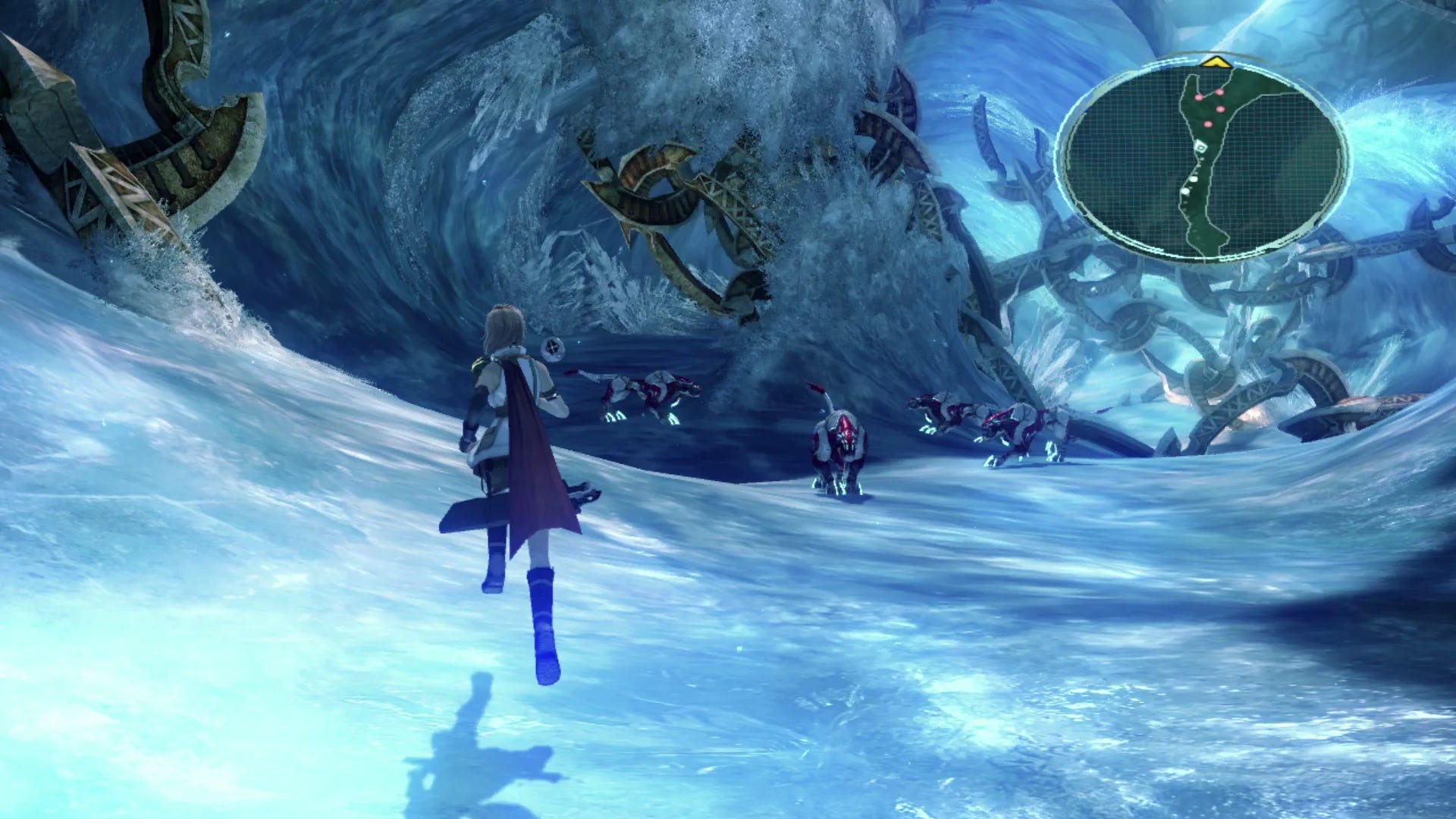
However, I suspect many of the issues I have with map/level design stem from what a chokehold technology (rather than art design) had on the final product. Getting environments like these run to on a PS3 above 10 frames per second requires a rigid control of the environment and sightlines. So one possibility is that technical boundary pushing prevented the game from having more open areas as the norm. Another is that the developers were more interested in a more straightforward, or (ugh) “streamlined” experience.
There are hints of this in certain areas. Gapra Wildwood features multiple references to it being a maze, and Lightning even vocalizes a hint about following beams of light to avoid getting lost. But in practice, well…see for yourself.
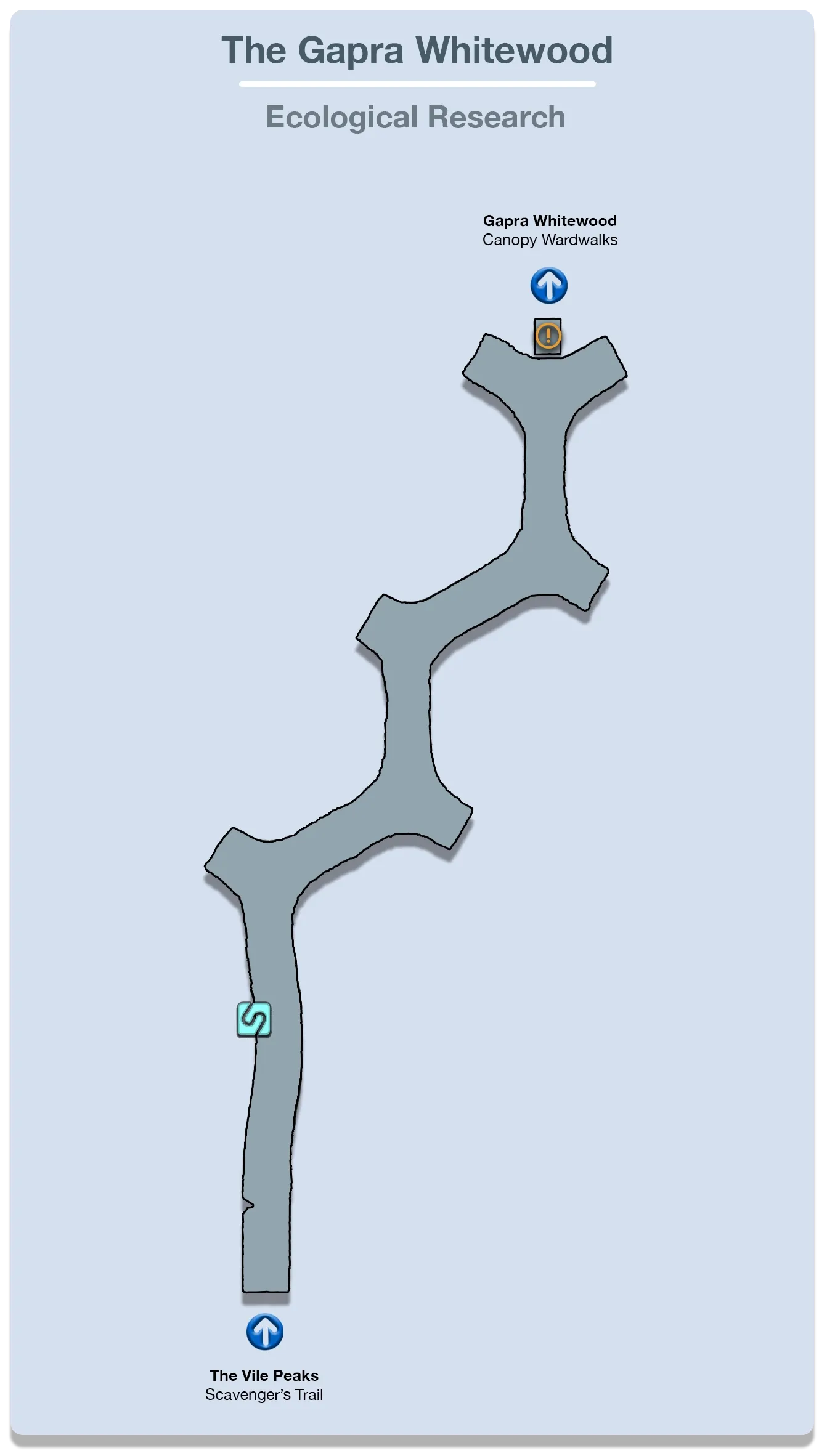
Above is the first map of the Gapra Wildwood, which is similar to most areas in the game. It’s not even possible to get lost here, so I’m not sure what all the fuss was about. The little nubs to the side in game look like off paths, which I suspect were originally side routes that were then cut. That’s a good capsule for the experience of playing FF XIII as a whole. Almost every dungeon (so to speak) and conversation feel lightly lobotomized: the interesting parts cut away in pursuit of spectacle. There is something arrogant about the makeup of the game, as if the text is so confident that we’ll be blown away by its visuals and enraptured by its story that the rest doesn’t matter. That’s my true issue with FF XIII: treating fundamental elements of its own game as grudging necessities.
At least the music rocks.
So What?
While not outright despising it, I ultimately didn’t care for FF XIII. Good for me. Sound the alarm for when someone expresses a commonly held opinion. However, the way in which I didn’t like it — particularly the linear map design — exposes certain lessons, or even lies, that JRPGs follow to create a good experience. I wrote this short review because I can’t stop thinking about how my mild dislike of FF XIII seems to illuminate the inner workings of the JRPG genre itself.
In other words, why is the hallway —> battles —> cutscene flow so different than navigating a dungeon? Is there anything substantial in how other JRPGs work, or is it all just a magic trick?
Stay tuned for more thoughts on that, and how FF XIII helped me arrive at some interesting conclusions.
Recommended Reading, Etc.
My installments book club has wrapped up Middlemarch, and it has been the most pleasant book club experience of my life. Living alongside a great novel for several months was a joy, and I highly recommend you start your own. Middlemarch itself was one of the most humane books I’ve ever read, featuring a masterful use of point of view.
After my disappointment with FF XIII, I decided to revisit Final Fantasy VIII for the first time in many years. I haven’t played it all the way through since high school, though I dipped into the first disc around 10 years ago. FF VIII is another polarizing title in the series, but it clicked with me this time. Its strange world drew me in, along with systems that encourage messing about. I’m playing blind but still managed to max out Squall’s strength by the end of disc two. I think there are plenty of strange decisions and stupid character moments, but somehow they feel like part of the gestalt. It’s odd to say, but I don’t think FF VIII would be as enjoyable if it were consistently good. What has enhanced my experience is listening to Retrograde Amnesia’s podcast playthrough of the game.
What with Nolan’s adaption gracing theatres, I’ve heard some discussion on the best translation of The Odyssey. While there are plenty of contenders, my left field suggestion is the older prose translation by Samuel Butler. Butler was a late Victorian novelist, and his approach to the language, especially treating it more as a straightforward novel, gives it a very different flavour than more modern translations.
I read Robertson Davies’ Fifth Business in high school, and it’s stuck with me ever since. A lightly strange novel full of musings on history and saints, it exudes a steady warmth and eye for a good story. I’m not as much of a fan as the other entries in the loose Deptford trilogy, but luckily Fifth Business can be read as a standalone. I do think The Manticore is worth praising for its unusual structure, as the entire novel is a series of therapy sessions.
Next Time
We’ll generalize a bit look at why FF XIII’s flaws are interesting, particularly when it comes to exploration.
FF XII is one of my favourites, for instance.
Even Luke from Tales of the Abyss, who is often cited as an example of good character development, settles into a static character once he cuts his hair around 2/3rds of the way through. And he’s the protagonist.
Note I said “change” instead of “grow.” It’s a persistent annoyance of mine in media criticism when people equate a character arc with said character becoming a better/nicer person.
Regular readers will know that I love RPG towns.
Sometime around the release of the The Bouncer (sorry, I meant…the BOUNCER), the creative leads as Square Enix seemed to have developed a love affair with straps and wallet chains that lasted more than a decade.
I think I'd have really enjoyed the combat if they gave you degree of control you get around 30 hours in after like 5 hours instead.
Yeeeeesss, I had this exact train of thought. FFX is literally a one way pilgrimage and then only really opens up the airship for free exploration toward the very end and yet they planned it so it was never boring or stale. Most of the kh2 maps are just long hallways with enemies scattered through and yet it feels amazing to play. And yet xiii just does not work.
I think I heard somewhere that the director deliberately planned the gameplay to feel constrained to one path to help us empathise with the characters’ feelings of being trapped. That is, until the point where the character growth led them to accept greater freedom and then they give the player more space to play around in. That sounds like a great… scratch that, let’s say ‘okay’ idea in theory but 1) you still have to actually make that feel good to play and 2) most people I’ve heard talk about this agree that the freedom comes too little too late.
(And yet they basically did a rerun of the same thing toward the end of ffxv and were surprised that people didn’t like that either 😑)
This is where I now admit that I haven’t actually played xiii past the first few hours. I reluctantly decided it wasn’t worth my time. But I’ve been trying to grieve and process that for years since. (Kind of same for Ffxv but in reverse. I loved so much of that game and played it all the way through and then the ending left me grieving for what might have been.)
I still own my ps2, Wii and game boy. I have never been one to suffer bad gameplay or writing for spectacle and good graphics.